PlexusDesign Agency WordPress Theme
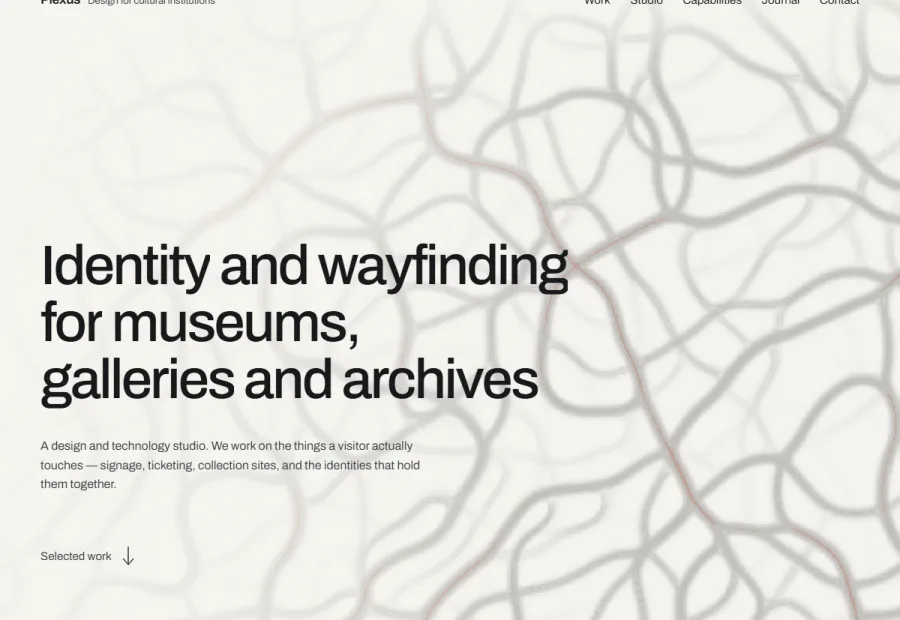
A portfolio theme for studios that sell on their work, on a live GPU transport network that grows toward the page's own content.
 Open live preview ↗
Overview
Who it is for
Plexus is for a firm whose sales case is “look at what we have done” — a design or branding studio, a digital product team, an architecture practice, a consultancy, a production company. Typically five to thirty people, where the website’s job is to convince a prospective client that you have solved their kind of problem before.
It is not a general business theme with a portfolio page bolted on. Projects, people and capabilities are three separate content types with their own fields, archives, templates and schema. A project carries its client, year, scope, what changed and a client quote, and can be set to run at lead, wide, middle or aside width so the front page lays each piece out at the size it earns rather than in a grid of equal cards.
The two taxonomies are called discipline and sector — deliberately generic, so an architecture practice or an engineering consultancy can use them without renaming anything.
About the demo content
The demo shows a studio that works with museums, galleries and archives. That is a choice about legibility, not a limit on the theme: a portfolio demo full of unrelated work reads as a studio with no expertise, which is the opposite of what a portfolio is for. Swap the six case studies for your own and the theme does not know the difference.
The background is a simulation, not a picture
Several hundred thousand independent agents run the Physarum model (Jones, 2010) entirely on the GPU in WebGL2 — no three.js, no third-party JavaScript at all. Each agent smells the trail map ahead of it through three sensors, turns toward whichever direction smells strongest, steps forward and deposits a little trail of its own. Nothing tells them to build a network; they build one anyway, because reinforcing a path others already took is locally the cheapest thing to do. Four passes run per frame: move, deposit, blur-and-decay, paint.
The one departure from the classic model is what stops it being decoration. The sections and cards actually on screen emit scent into the trail map, so the network grows toward real content and rewires as you scroll. It is rendered as ink on paper rather than the usual neon on black.
Legibility is a budget, not a hope
Body text sits directly on the simulation, so how dark the field may go is capped in the shader, and every text colour was checked against the darkest, most strongly coloured pixel the field can ever produce — clearing WCAG AA at 4.5:1 on that worst case, not merely on flat paper. One consequence is visible in the design: there are two text tones rather than three, because over a live ground no light grey clears the threshold. The third level of the hierarchy is built from size and weight instead.
Degrades rather than dies
The simulation measures its own frame time and steps down through reduced tiers — fewer steps per frame, then a smaller trail map — before it gives up. Only at the bottom of that ladder does it stop and hand the page back to flat CSS, so a weak GPU gets a smaller live network rather than a dead page. Visitors who ask their system for reduced motion never download the simulation or its shaders at all.
Editable in the preview
Colour, motion, the front page’s copy, the listing introductions and the header and footer text are all in the Customizer, and every one updates live without a reload — including the colours the GPU uses, which it re-reads from the stylesheet rather than keeping a private copy of. Set the background to Calm and the simulation is never loaded for anyone.
What's included
- Full theme source — every template, style sheet & script
- One-click demo importer (idempotent, no page builder)
- Live Customizer controls for copy, colours & content
- Translation-ready .pot file + RTL stylesheet
- HTML documentation + a CHANGELOG file
- Lifetime updates + 6 months support (renewable)
Specifications
| WordPress | 5.6 – 7.0 |
|---|---|
| PHP | 8.0 – 8.3 |
| Browsers | Chrome, Firefox, Safari, Edge (latest) |
| Layout | Fully responsive, mobile → desktop |
| Localization | Translation-ready · RTL included |
| Accessibility | Keyboard-navigable · prefers-reduced-motion |
| Page builder | Not required — native Customizer |
| License | GNU GPL v2 · single-site commercial |
Release
The complete, dated version history ships in the theme’s CHANGELOG file. Every purchase includes lifetime access to future updates.