WeirLandscaping WordPress Theme
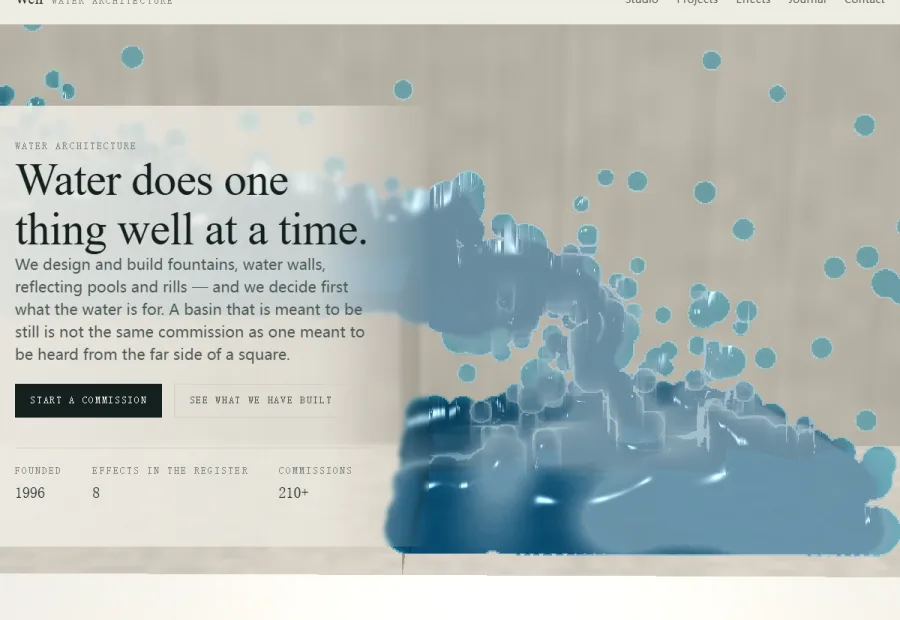
Weir is built for architecture and institutional water-feature work, structured around a real WebGL2 fluid engine — continuous fluid surfaces rendered with real-time caustics, not a looping video standing in for water. True to its premise, water does one thing well at a time as you scroll, with CSS scroll timelines pacing each surface change. No page builder sits between the content and the render, keeping the whole site as controlled as the water it depicts.
 Open live preview ↗
Highlights
- The hero is a real weir, not a video and not a particle spray: three continuous water surfaces solved live — a shallow approach film running to the brink, the falling curtain, and the pool it lands in. Because they are surfaces, the water is continuous by construction; there is nothing to merge and so nothing that can fail to merge
- The falling curtain is physics, not a loop. Its shape is projectile motion, so it leans clear of the weir face by exactly the distance the approach velocity carries it while it falls; it thins as it accelerates because thickness times velocity is constant; and it whitens with fall distance the way a real nappe breaks up — glassy at the lip, fully aerated by the time it lands
- Move across the hero and you open the gate. More flow means a faster, thinner sheet that throws further out from the wall — the one control a fountain engineer actually has, wired to the one thing a visitor will try
- What is behind the water genuinely bends. Refraction is driven by the live surface normal and scaled by real thickness, and colour is Beer–Lambert absorption, so deep water is not “more blue” — it is less red, exactly as water is
- Real caustics in the reflecting-pool section, computed rather than painted. A grid of light rays is refracted through a live wave-equation surface by Snell’s law and deposited where it lands on the floor; the bright lines are simply where many rays coincide, which is what a caustic physically is. Poke the pool twice and the crossing wavefronts interfere
- The jet diagram is integrated from fountain hydraulics in PHP, not drawn: nozzle pressure and velocity coefficient set the launch speed and quadratic drag takes height back, so the aerated jet is fed harder than the laminar one and still finishes lower. Change the pressure in the content and the drawing changes
- Every scroll reveal is native CSS <code>animation-timeline: view()</code> — there is no IntersectionObserver anywhere in the theme, and the animation is applied only inside <code>@supports</code>, so on any browser without scroll timelines the content is simply, permanently visible
- A cascade layout: bands alternate their horizontal offset with a hairline channel stepping between them, so the page has a stepped rhythm rather than the centred stack every other theme resolves to — while still being an entirely ordinary vertical scroll
Overview
Weir is built for the studios that design water itself — fountain and water-feature designers, landscape architects with a water practice, and the aquatic-architecture arms of larger firms. It assumes the thing being sold is an engineering judgement, not a picture: what the water is for, what plant room it needs, and who maintains it in February.
The signature is not a shader that resembles water. It is three continuous water surfaces solved live and lit as one body: the shallow film accelerating over the crest, the falling nappe, and the pool it lands in. The nappe follows a real ballistic trajectory and thins as it speeds up, because continuity requires it to; the pool is a wave equation integrated on the GPU. The surfaces are continuous by construction, so there is nothing to reconstruct and nothing to merge.
Content types cover installations, a register of water effects with the nozzle and pressure data a designer actually quotes on, and a private enquiry inbox.
What's included
- Full theme source — every template, style sheet & script
- One-click demo importer (idempotent, no page builder)
- Live Customizer controls for copy, colours & content
- Translation-ready .pot file + RTL stylesheet
- HTML documentation + a CHANGELOG file
- Lifetime updates + 6 months support (renewable)
Specifications
| WordPress | 5.6 – 7.0 |
|---|---|
| PHP | 8.0 – 8.3 |
| Browsers | Chrome, Firefox, Safari, Edge (latest) |
| Layout | Fully responsive, mobile → desktop |
| Localization | Translation-ready · RTL included |
| Accessibility | Keyboard-navigable · prefers-reduced-motion |
| Page builder | Not required — native Customizer |
| License | GNU GPL v2 · single-site commercial |
Release
The complete, dated version history ships in the theme’s CHANGELOG file. Every purchase includes lifetime access to future updates.